 Llama Builder
Build a single door, a double pair or an open archway, in your own shape and paint. In the game, doors are in Build mode under Doors. Each color and finish variant is one swatch, and the panels every type shares are on The Editor.
Door Kind
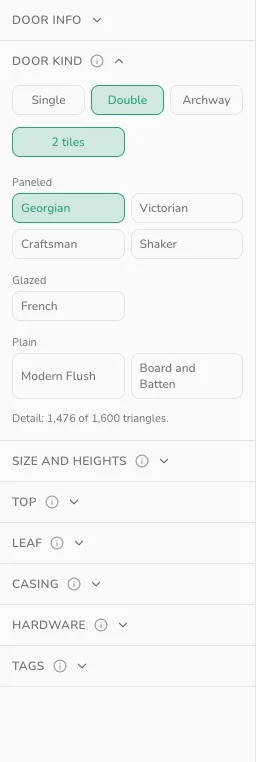
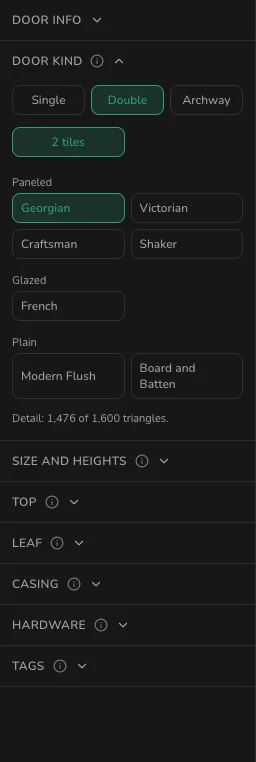
Single is one leaf, Double a pair that opens together, and Archway an opening with no leaf at all.
- 1 tile or 2 tiles: how much wall the door claims. A double comes in two.
A 2-tile single is EA's own wider door standing centered between the two squares, 1.10 m across, rather than a hole twice as wide.
Styles sit under the kind, in four groups. Paneled holds Georgian, Victorian, Craftsman and Shaker; Glazed holds French; Plain holds Modern Flush, Cottage and Board and Batten; Archways holds Square, Round, Gothic and Segmental. A style replaces the leaf, the head and the casing, so pick one first and shape it after. Only the styles your kind can wear are listed.
Size and Heights
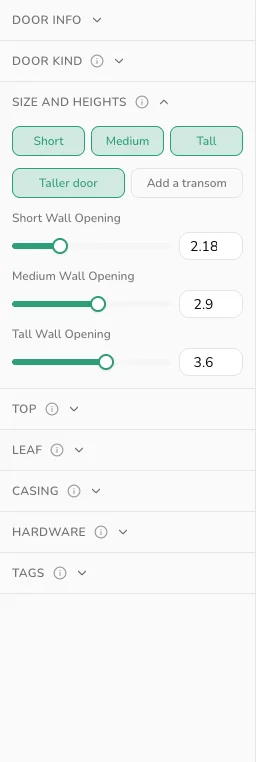
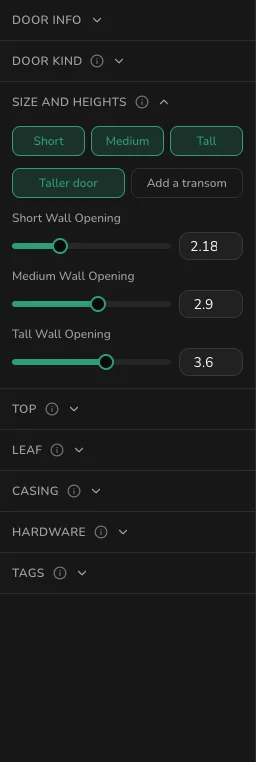
Short, Medium and Tall pick the walls your download covers. The game builds walls 3, 4 and 5 metres tall, and each height you tick gets its own entry in the catalog. One stays ticked, because a door is built for at least one wall.
Taller door grows the opening with the wall. Add a transom keeps the leaf the height you set and fills the rest with a light over it.
- One Wall Opening slider per height you carry: the hole in metres, floor to head.
- Leaf Height: the leaf itself, while a transom stands over it.
In the toolbar, Preview wall stands the door in one of the heights you carry and Door closed swings the leaf open on its hinge. Neither changes the download, and the catalog tile always bakes closed.
Top
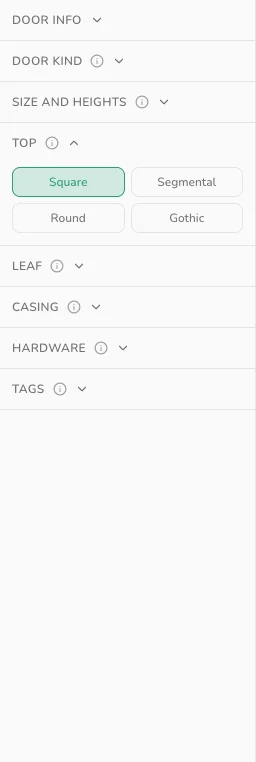
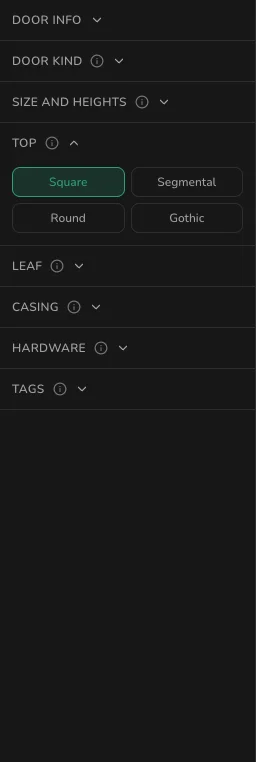
Square, Segmental, Round and Gothic shape the head over the jambs, and Rise lifts a segmental arch from almost flat to a deep curve. Round is half the opening's width and Gothic 0.87 of it, so neither takes a rise.
An arched head is the dearest step here: it sweeps its arcs through the frame, the casing and the leaf's top rail at once.
Leaf
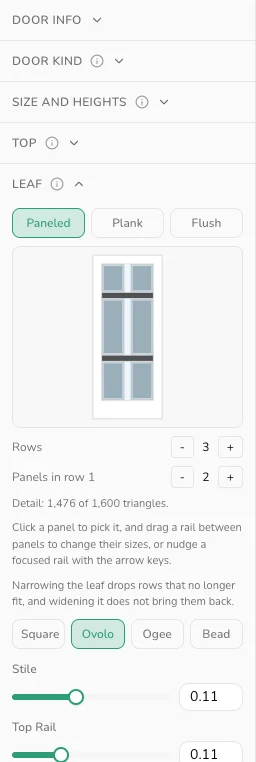
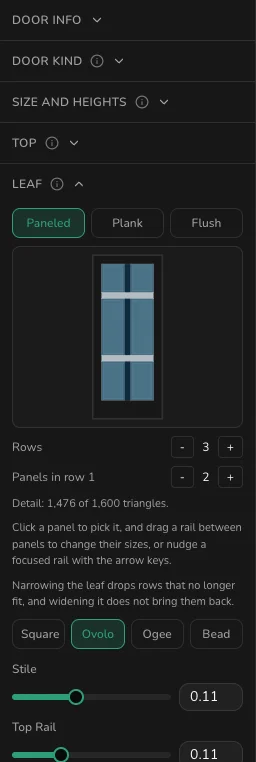
- Paneled, Plank or Flush: panels in a grid, vertical boards, or one flat slab.
- Square, Ovolo, Ogee and Bead shape every raised panel's edge.
- Boards, then Z brace or X brace: a plank door's boards and the ledges across them.
- Stile, Top Rail and Bottom Rail: the leaf's own members, in metres.
- Lock rail puts one more member across the leaf, at Lock Rail Height.
- Thickness: how far the leaf's two faces sit apart.
Panel Grid
The elevation divides a paneled leaf into rows and columns. Tap a panel to walk it through flat, raised and glass, and drag a rail to re-weight the rows either side. The grid is drawn at the shortest wall you carry, and every taller wall takes its panel heights from it.
Narrowing the leaf drops rows that no longer fit, and widening it does not bring them back. Undo is the way back.
Glass
Bars Across and Bars Down divide every glass panel. A bar is drawn again in every pane that repeats it.
Tint and Opacity set the glass color and how much it hides. The package carries one pane material, so the glass reads the same on every swatch.
Transom
The light over the leaf, under Add a transom only. Glass takes Bars across it, and Panel is solid and takes none. A wall whose opening is no taller than the leaf has no room for one, and the editor says so.
Casing
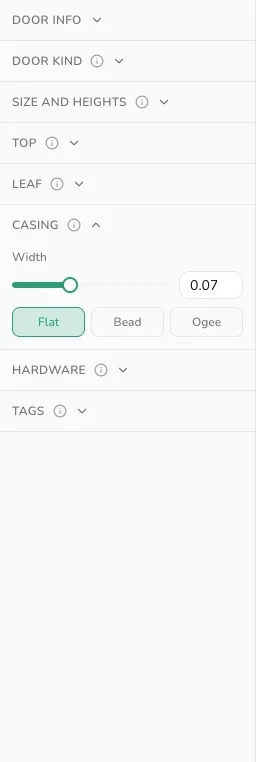
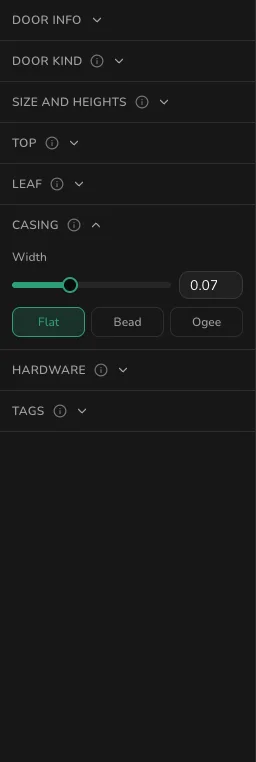
- Width: how far the trim reaches onto the wall around the opening, on both faces. At 0 there is no casing.
- Flat, Bead and Ogee: its profile. A bead or an ogee adds a band to each face.
Hardware
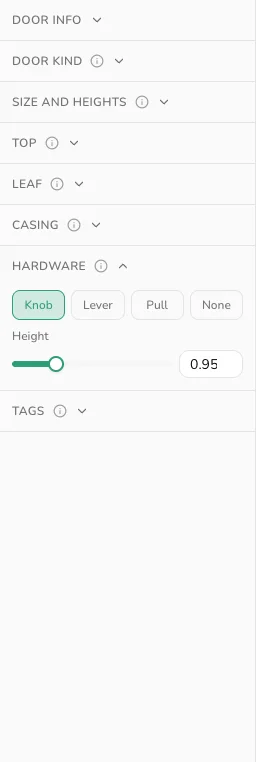
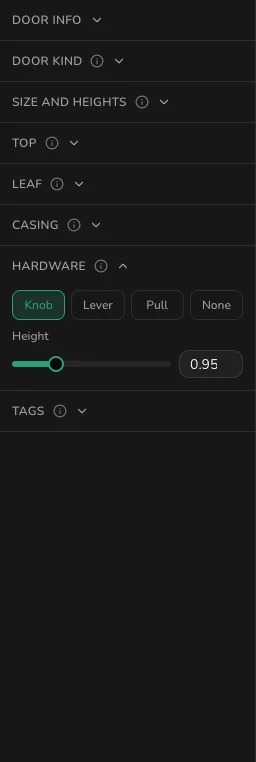
An archway has no leaf to hang a handle on, so it has no Hardware panel.
Set
Seven tiles: Georgian, Victorian, Craftsman, Mid-century, Modern, Rustic and None. A tile writes the whole handle the way that period wore it, from Georgian's egg knob to Rustic's thumb latch. Your handle height and the room side stay as you set them, and anything you change afterwards is yours. A door style never touches the hardware, so any door takes any set.
Handle
- Knob, Lever, Pull, Thumb latch or None: what the leaf wears.
- Its shape: six knobs from Ball to Knurled, five levers from Straight to Square, or a Bar, D or Ring pull.
- Knob Size and Knob Projection, Lever Length or Pull Length: the handle's size in millimetres. Try 57 mm across for a knob and 127 mm for a lever.
- Height: how far up the leaf the handle sits, on both faces. Try 0.95 m for a lever.
Each kind keeps its own shape and size, so switching to a lever and back brings your knob back as it was.
Mount and Keyhole
Rose stands the handle on a small plate, in five shapes at the width Rose Size sets. Plate swaps that for a long sideplate, Plain, Slim or Ornate, in four lengths from 178 to 254 mm. A face carries one or the other, never both.
Keyhole puts None, a Lever key bullhole, a Euro pear or a Round cylinder under the handle. On a rose it gets a small plate of its own; on a long plate it sits at the lower end.
Inside Differs
Turn it on to give the room side a handle of its own, with the same rows again: type, shape, size, mount and keyhole. It starts as a copy of the outside handle, so the door looks the same until you edit it. Turn it off and the room side mirrors the outside again. A thumb latch runs through the leaf and works both faces, so it has no room side to set.
Lock
Deadbolt adds a second lock over the handle: a key outside, a thumb turn inside, and a bolt of its own on the edge. Compact 92 mm and Standard 140 mm set how far over the handle it sits, and Oval or Bar shapes the turn.
On a long plate the bolt and the handle share the plate's own two bores, so the plate's length sets how far apart they sit and the spacing chips go quiet. A tall pull or a thumb latch does the same: the bolt stands clear above it instead, and the editor says how far.
Square, Rounded or Drive-in shapes the faceplate on the door's edge, and Plain or Full lip the strike in the jamb it shuts against. Both show on an open door. A door with no handle on either face carries no latch and no deadbolt.
Hinges
Hinges are on for a new door, and off on a door you saved before they existed, so an old project keeps the look it had.
- Butt, Strap, Tee or Hook and band: a butt hinge is let into the door's edge and shows its barrel from the room. The other three are one band laid across the room face, on a pin in the frame.
- Auto reads the leaf's height for the count, 2 on a short door up to 5 on a tall one, or pick the count yourself.
- A butt hinge takes a Button, Ball, Steeple, Urn or Acorn tip at each end of its barrel, with 3 or 5 knuckles.
- A band takes Band Reach, a share of the leaf's width, and a Plain, Penny, Arrow, Spear or Fleur end. Try 66% across a plank door.
A plank door with ledges hangs its bands on those three ledges, which is the timber a band is screwed to, so the count chips go quiet there. Hinges are the heaviest hardware a door wears: a tall leaf hangs on five of them, and each is a barrel, its knuckles, its two tips and two leaves.
Studs
Studs are clavos, the nail heads hammered through the outside face of a studded door.
- Round, Pyramid, Square or Rosette: the head's shape.
- Stud Size: how wide each head is, 12 to 32 mm. Try 20 mm.
- Ledges, Grid or Border: where they go. Ledges follows a plank leaf's own ledge lines, and the panel rows on any other leaf.
The field keeps clear of the handle, the way a real studded door does, and stops at four columns by six rows.
Door Furniture
Four pieces an entry door wears, each with a switch of its own. All four start off, on a new door and on a door you saved before them, and no hardware set turns one on or off: any door takes any furniture.
- Kick plate: a metal plate across the foot of the leaf. Kick Plate Height runs 150 to 400 mm, and Push (street), Pull (room) or Both picks the face it is screwed to. Try 254 mm on the push face.
- Letterbox: a letter plate through the leaf, a sprung flap outside and a tidy plate inside. Slim, Standard or Ornate sets every size of it, and Letter Plate Height runs 760 to 1,640 mm, which keeps the plate's own edges inside the 700 to 1,700 mm a letter plate belongs in.
- Knocker: Ring, Loop, Regency, Doctor's or Art Deco, on the outside face at Knocker Height, 1,300 to 1,600 mm.
- Viewer: a peephole bored through the leaf, a bezel and lens outside, an eyepiece inside. Accessible pair bores two of them, at 1,050 and 1,500 mm, so someone seated has one to use; off, Viewer Height sets the single one.
The letter plate, the knocker and the viewer are centred on the leaf and need solid timber behind them, so each moves to the nearest height that will take it, clear of the glass and of the pieces above it. A kick plate is shortened to stop under the lowest pane instead. The editor says where every piece really went, at each wall height your download carries, and says so when a leaf has no band for one at all.
Door Colors
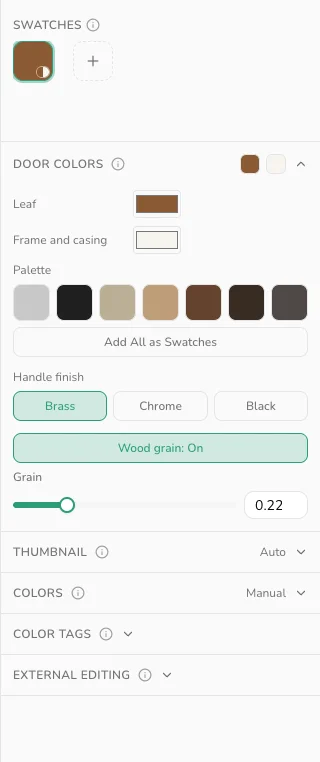
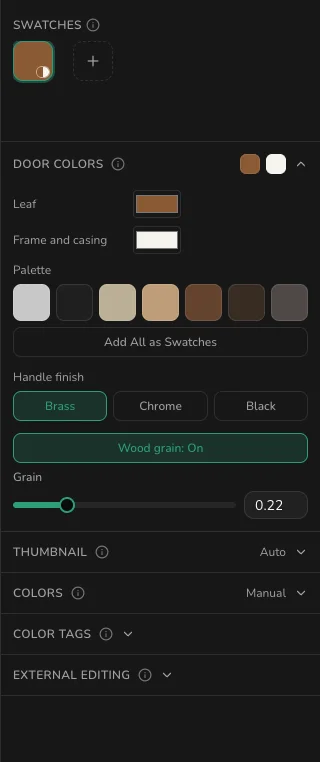
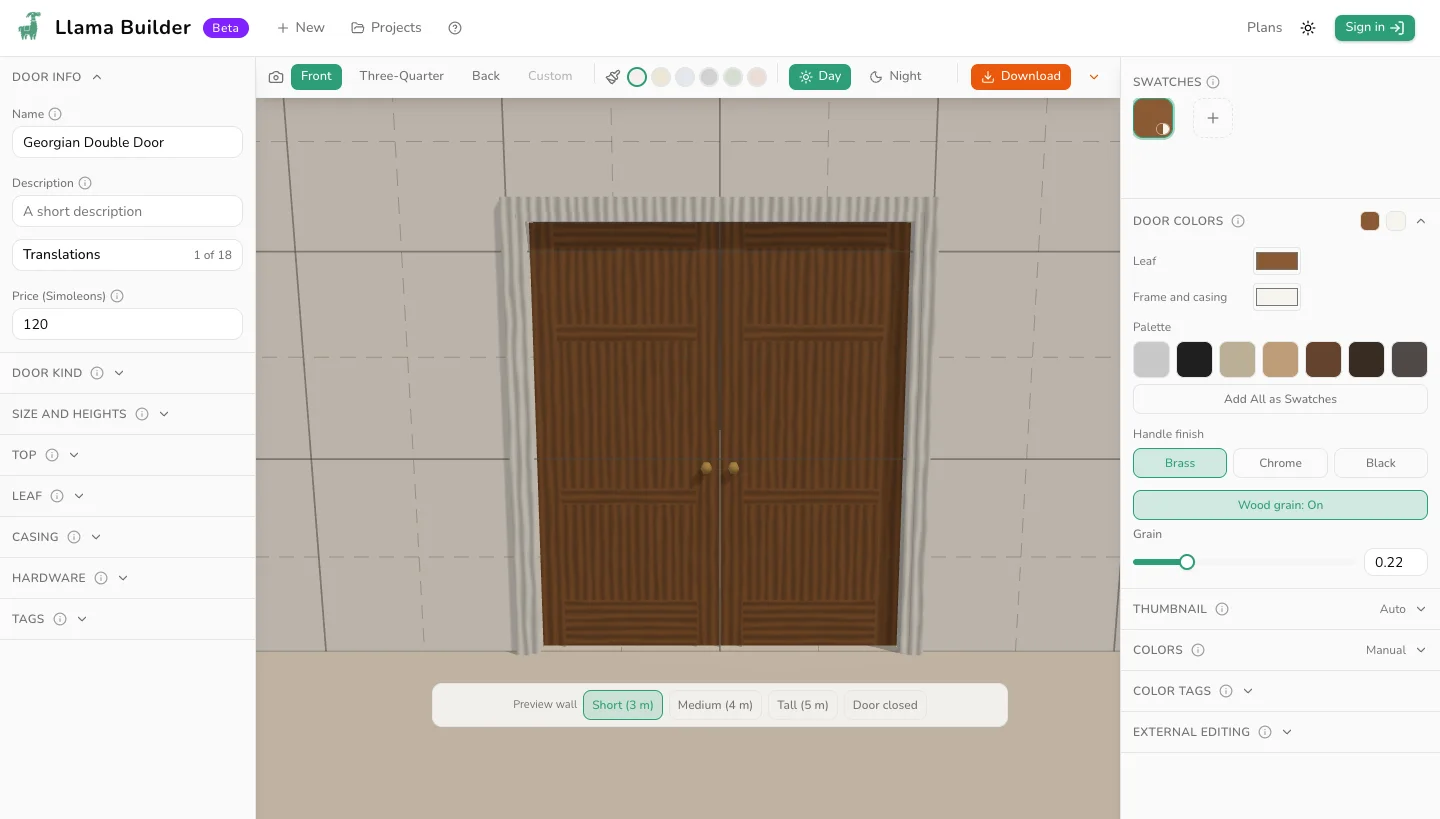
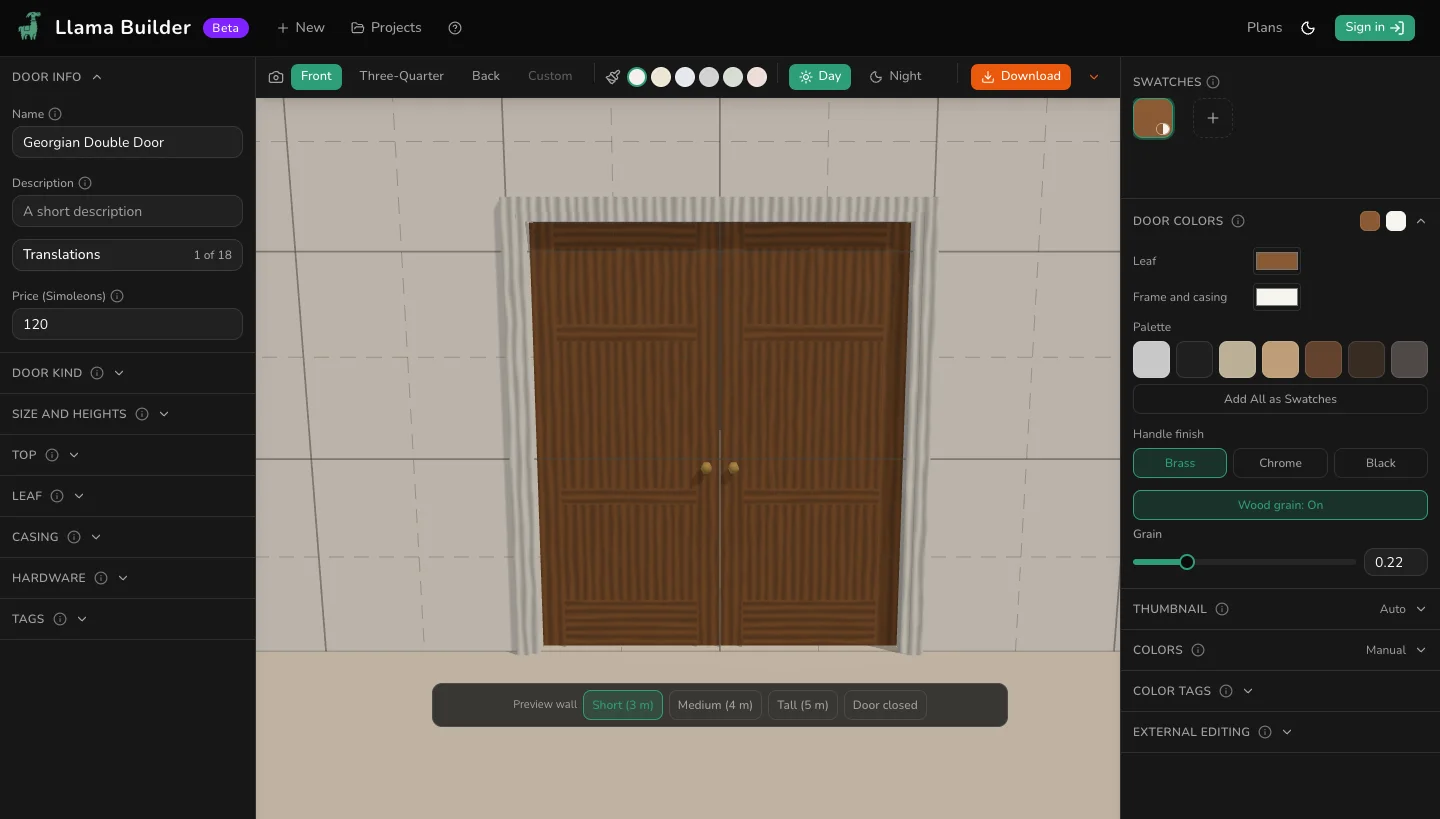
Leaf paints the door, and Frame and casing paints the lining, the jambs and the trim together. The Palette holds EA's own wood paints: a chip recolors this swatch, and Add All as Swatches makes one swatch per chip.
Hardware finish is the metal every part takes, ten of them from Polished Brass to Copper. Under it, Handle, Lock, Hinges, Studs and the four furniture pieces each take a finish of their own, as a row of dots: the first dot is Same as base, the rest are the ten finishes, and each dot names its finish when you hover it. Handle covers the rose or plate with it, Lock the keyhole, the deadbolt, the latch and the strike, and Hinges the tips. A row stands once the door really wears that part, and each swatch sets its own, so one design can ship brass and black together.
Custom color paints the hardware in a color of your own instead of the finish's, and every part row ends with the same picker. The finish still sets how shiny the metal is, so Polished Brass in your own color keeps its mirror sheen rather than reading as paint. Clear brings the finish's color back on the base, and picking any dot in a part's row brings that part's back.
Wood grain lays figure over the color, and Grain sets how strong it is.