 Llama Builder
Build a window in any size, from a small kitchen window to a wall of glass. In the game, windows are in Build mode under Windows. Each color and glass variant is one swatch.
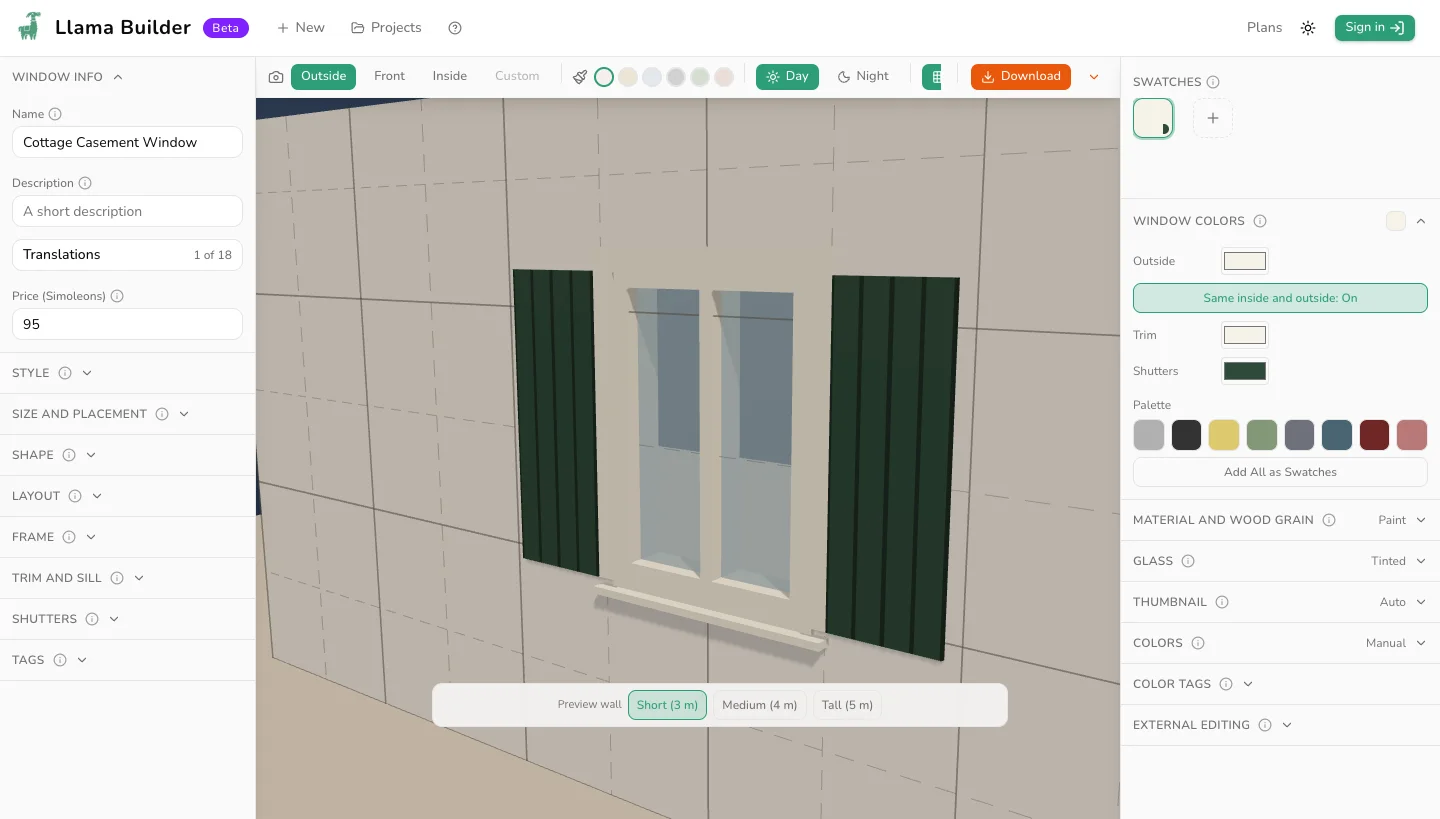
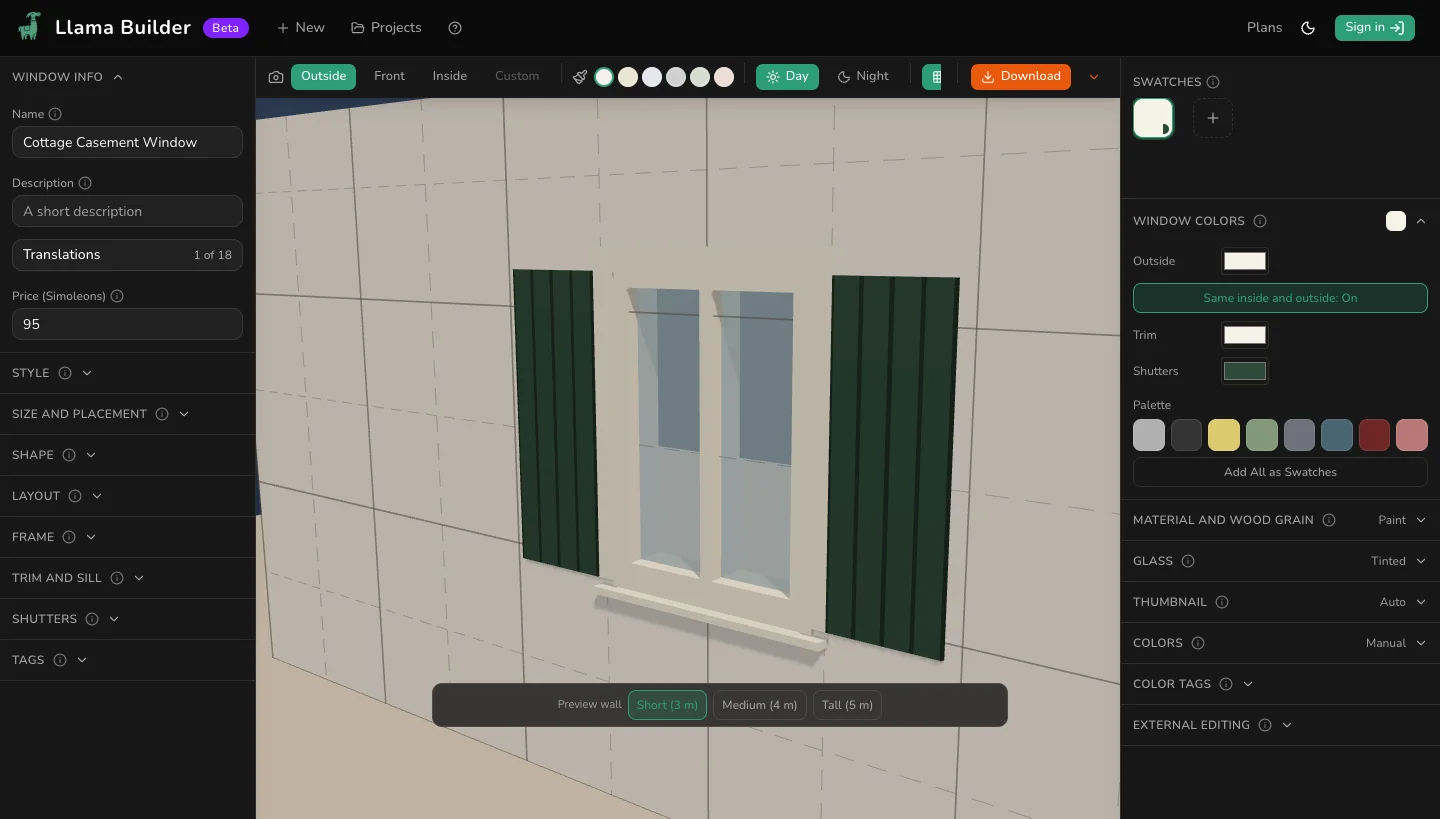
Style
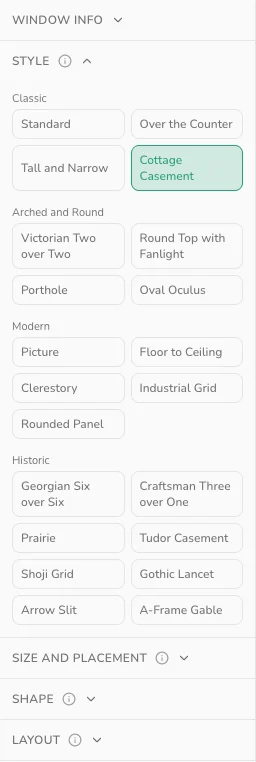
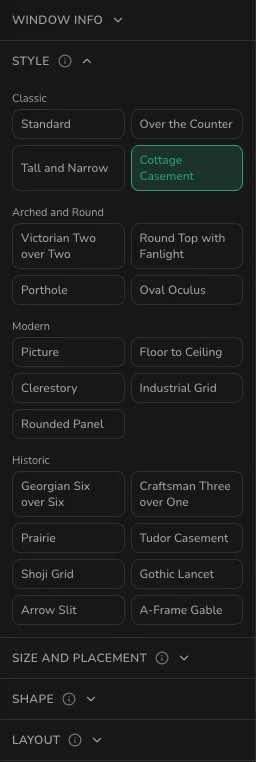
Finished windows to start from, in four groups. Classic holds Standard, Over the Counter, Tall and Narrow and Cottage Casement, which comes with its casing, sill board and shutters already on. Arched and Round holds Victorian Two over Two, Round Top with Fanlight, Porthole and Oval Oculus. Modern holds Picture, Floor to Ceiling, Clerestory, Industrial Grid and Rounded Panel. Historic holds Georgian Six over Six, Craftsman Three over One, Prairie, Tudor Casement, Shoji Grid, Gothic Lancet, Arrow Slit and A-Frame Gable. A style replaces the whole shape, so pick one first and size it after.
Arrow Slit carries the shape alone. To leave the slit standing open, as a castle's does, pick Open under Glass.
Size and Placement
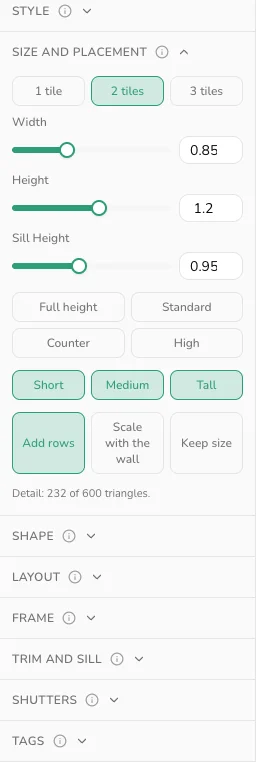
- 1 tile, 2 tiles or 3 tiles: how much wall the window claims. The hole can be almost this wide, less a little jamb either side.
- Width, Height and Sill Height: the hole in metres, and how far its bottom sits above the floor. 1 m is about one tile.
Placement
Full height runs the hole from the floor to the top of the wall. Standard puts a 1.3 m hole at 0.9 m, Counter a shorter one at 1.15 m, and High a strip at 1.95 m. Setting Height or Sill Height yourself leaves the placement to you.
Wall Heights
Short, Medium and Tall pick the walls your download covers. The game builds walls 3, 4 and 5 metres tall. A height whose window comes out the same as a shorter one shares that entry, and the panel says which height covers it.
Under them, Add rows keeps the pane size and stacks more panes up a taller wall, Scale with the wall grows the whole hole with it, and Keep size leaves the window exactly as you drew it. A Circle, Oval or Triangle keeps its size whichever you pick, so one entry covers every height.
Shape
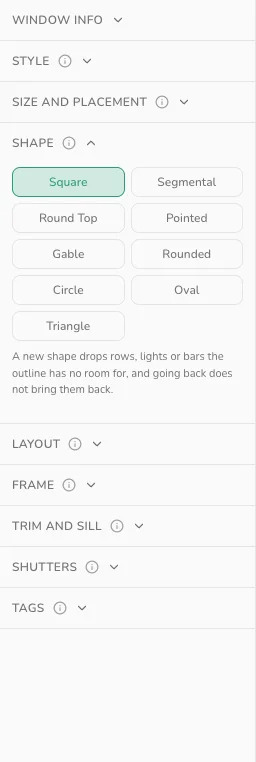
The hole's own shape. Square is a plain rectangle. Segmental, Round Top, Pointed and Gable put a head over straight sides. Rise sets how far a segmental head climbs and Point how sharp a pointed or gable one is. A round top takes its rise from the width, so it has no number of its own. Rounded softens the four corners by Corner Radius. Circle, Oval and Triangle are the whole hole.
The game cuts the wall to this shape, so the hole, the frame and the preview always match.
- A head needs room: on a wide, shallow opening the head springs just above the frame instead of reaching its full height, and the panel says so.
- A circle is one measurement, so its width and height stay the same as each other.
- Circle, Oval and Triangle carry no sill board, and a Triangle takes no keystone, because its top is a point rather than a crown. Only Square, Segmental and Rounded take shutters, because a shutter is a flat panel.
- Full height is off for Circle, Oval, Triangle and Rounded, because a frame that runs all the way round cannot sit on the floor.
Layout
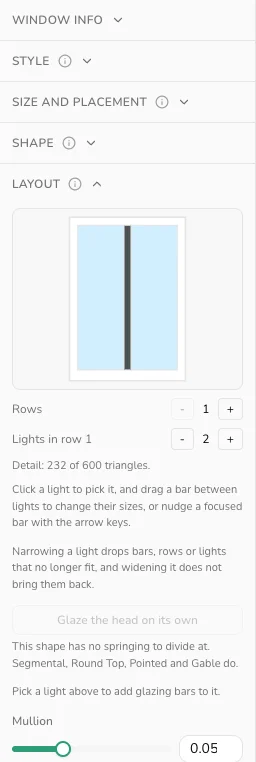
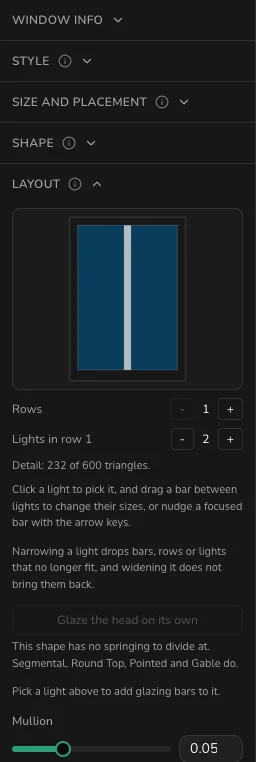
The elevation divides the opening into lights. Click one to pick it; drag a divider to resize both sides.
- Rows and Lights in row: how it divides. A new row copies the last, bars and all.
- Glaze the head on its own makes the head its own light above the springing. It needs a Segmental, Round Top, Pointed or Gable shape and a row under it. On a taller wall the head keeps its shape and the sash under it grows.
- None leaves the light clear; Colonial panes, Prairie an inset border, Diamond diagonals.
- Radial fans spokes out of the bottom of a head glazed on its own, which is what a fanlight looks like. Spokes sets how many.
- Bars Across and Bars Down stop at a 5 cm pane. Under Diamond, Diagonals Across and Diagonals Down stop at a 5 cm gap.
- Mullion, Transom and Bar Width: how thick each one is.
- Outside only draws the bars on the outside face alone, and reads the same from the street.
Narrowing a light drops bars, rows or lights that no longer fit; widening does not bring them back. Add rows stacks panes on a Colonial top row only; other patterns scale.
Frame
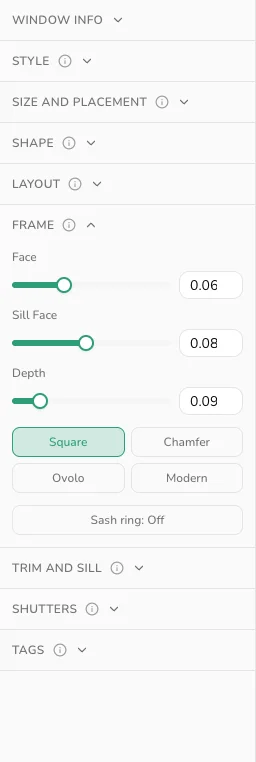
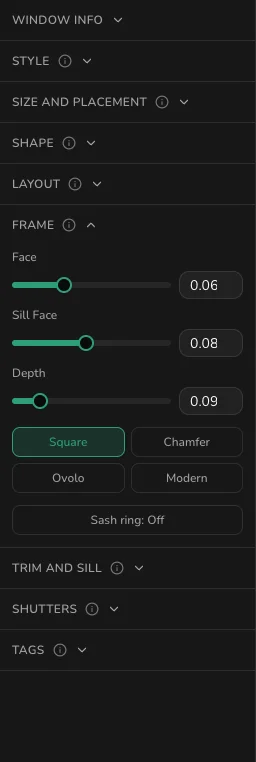
- Face: how wide the frame reads from the front, 2 cm to 15 cm.
- Sill Face: the board under the glass, usually a little wider than the rest.
- Depth: how deep the frame runs, from the middle of the wall out to each side. The wall is 15 cm thick, so 0.08 m just covers it and anything more stands proud.
- Square, Chamfer, Ovolo and Modern shape the front of the frame: a plain flat band, a step down toward the glass, a rounded bead, or a flat face with one crisp lip at the pane.
- Sash ring puts a ring of frame around every pane, on both faces, and Sash Face sets how wide the ring is. The smallest light caps that width, because every pane keeps some glass inside its ring.
A ring is four straight bars, so lights the head cuts into carry none.
Trim and Sill
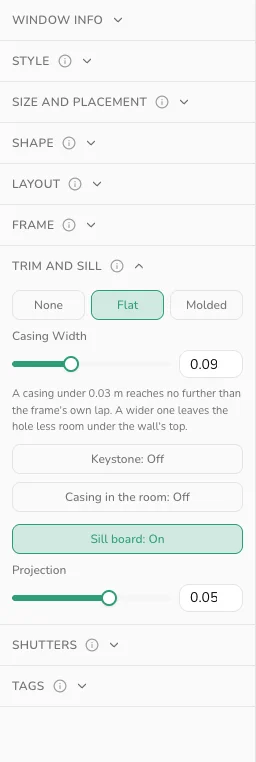
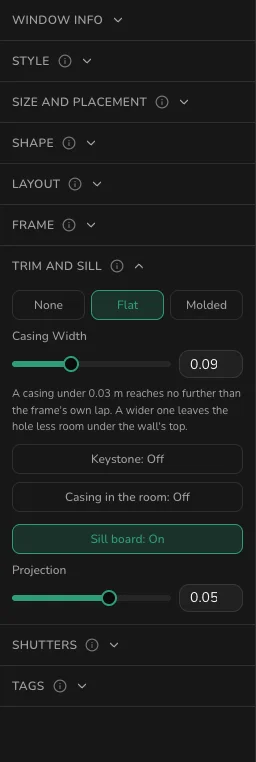
- None, Flat or Molded: the casing on the wall around the window. Molded adds a bead next to the glass.
- Casing Width: how far the casing reaches onto the wall. A wider one leaves the hole less room under the top of the wall, and it never reaches past the window's own tiles, so a wider casing needs more of them.
- Keystone sets a stone at the top, centered on the window. It stands on the casing, so give the casing some width first.
- Casing in the room repeats the casing on the inside wall.
- Sill board puts a board under the window, and Projection sets how far it juts out. A window that reaches the floor has no room below it for one.
Shutters
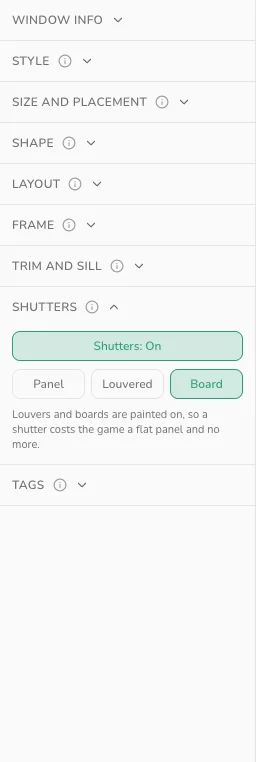
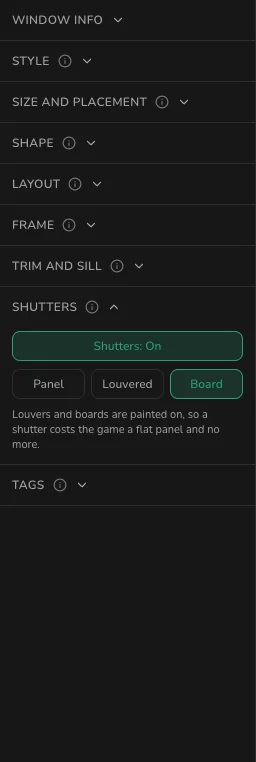
A panel each side of the window, each half the opening wide, so a closed pair would cover the glass. Panel, Louvered and Board are painted on, so a shutter costs the game one flat panel however it looks.
Shutters need half the window's tiles free beside the opening. A wide window, or a wide casing, is offered them only on more tiles.
Window Colors
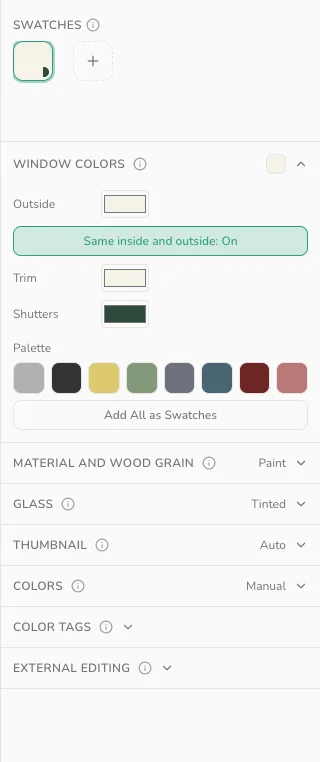
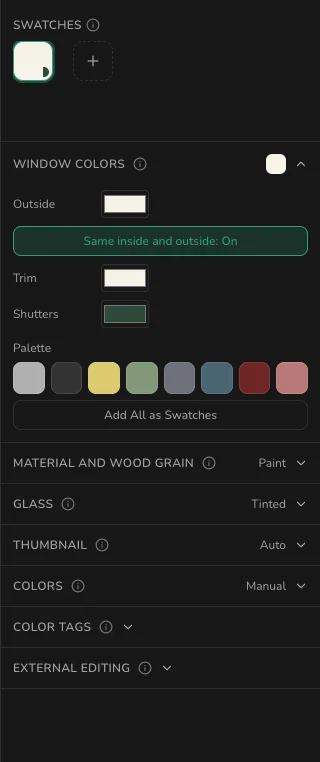
Outside paints the street side. Turn Same inside and outside off to give the room side its own color; the color you set there is kept, so you can link the sides again and find it waiting.
Trim paints the casing and the sill board, and Shutters the panels. Each one appears once the design carries that part. The Palette holds EA's own window paints: a chip recolors this swatch, and Add All as Swatches makes one swatch per chip.
Material and Wood Grain
Paint is flat, Wood takes a grain, and Metal catches more light. Grain sets how strong the figure is, and Vary the Grain picks another board.
Glass
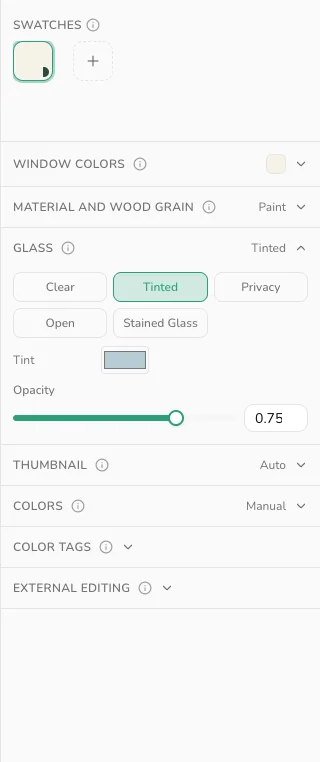
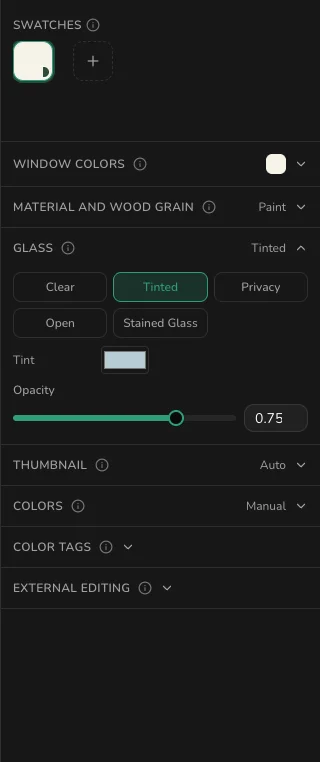
Clear is a plain pane. Tinted takes a color of your own and an Opacity, from barely there to almost solid. Privacy is frosted, so the light comes through and the room does not show. Stained Glass carries a picture of yours. Open leaves the hole empty, for an archway or a serving hatch.
Stained Glass
Pick Stained Glass under Glass, then upload a Picture. It spans the opening's narrower side, and the glazing bars read as its leading. Scale, Rotation, Across and Up place it in the opening.
Tint is the color of the glass wherever your picture is clear. Opacity stops short of solid, so a stained pane always lets some light through.
Each wall height your download covers gets its own copy of the picture, fitted to that height's opening.